

Today, businesses are turning to Internet of Things (IoT) technologies to manage their buildings more efficiently and reduce operational costs. Smart building management makes it possible to optimize everything from a building's energy consumption to its security, thanks to sensors, automation systems, and data analytics.
What is Smart Building Management?
Smart building management means the monitoring and control of all a building's systems — HVAC, lighting, security, fire detection, and energy management — from a centralized platform. IoT sensors continuously collect data from these systems, and AI-powered algorithms analyze this data to make automated decisions.
- Real-time monitoring: Temperature, humidity, air quality, and energy consumption are tracked instantly
- Autonomous control: Systems maintain optimal conditions without user intervention
- Data-driven decisions: Past data is analyzed to predict future needs
- Integrated management: All building systems are managed from a single dashboard
IoT Sensors and Building Automation
IoT sensors are the fundamental building blocks of smart building management. Each sensor measures a different parameter of the building and transmits this data to the central system.
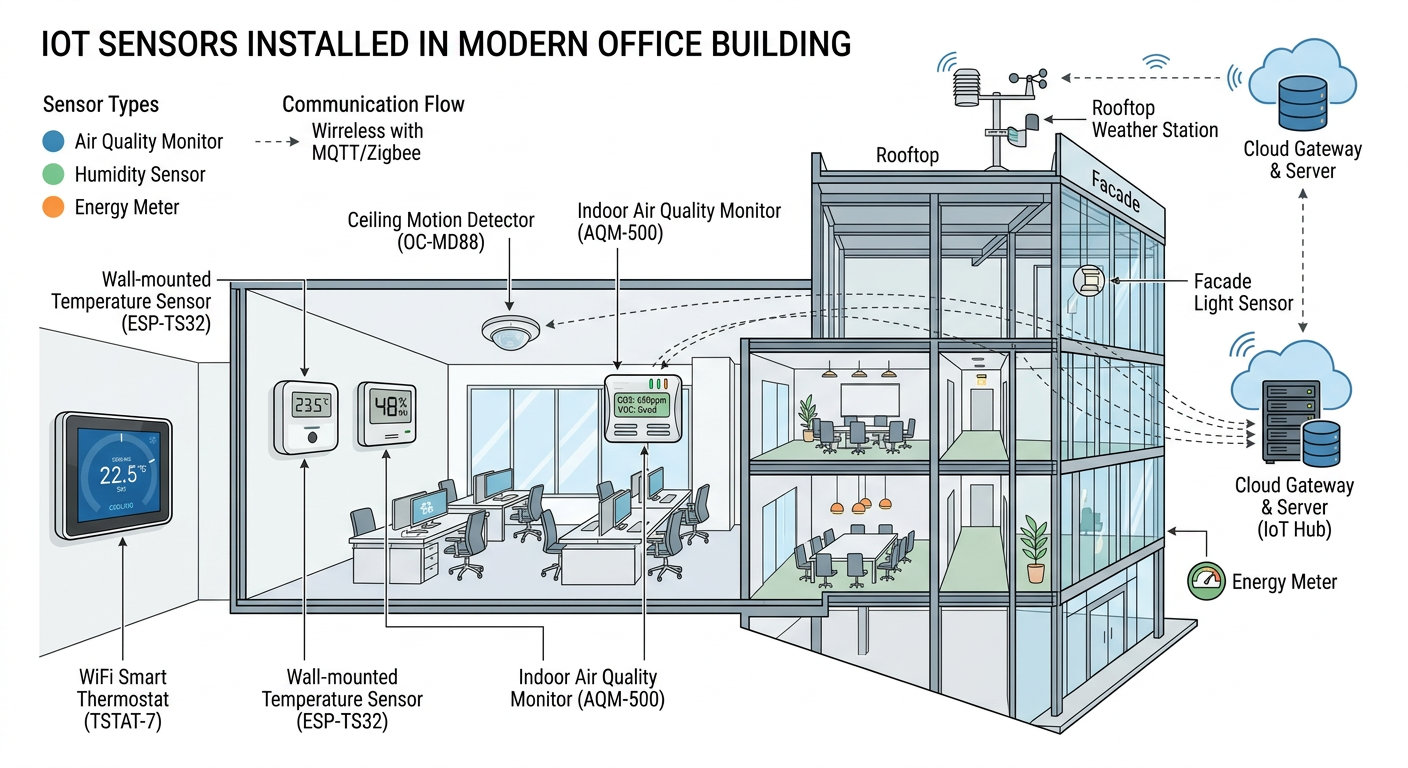
Commonly Used IoT Sensors
- Temperature and humidity sensors: Enable optimization of HVAC systems. Heating and cooling are automatically adjusted according to ambient conditions
- Motion and occupancy sensors: Save energy by turning off lighting and air conditioning in empty spaces
- Air quality sensors: Manage ventilation systems by monitoring CO2, PM2.5, and VOC levels
- Energy meters: Measure electricity, water, and natural gas consumption in real time
- Vibration and acoustic sensors: Monitor the condition of mechanical equipment and provide early warnings before failures
Automation Scenarios
When the data collected from these sensors is combined with automation rules, powerful scenarios are created:
- Automatically turning off all lighting outside of working hours
- Activating the air conditioning when occupancy is detected in meeting rooms
- Speeding up ventilation fans when air quality drops
- Sending instant notifications to managers when energy consumption exceeds a threshold
Energy Efficiency and Cost Savings
One of the most significant benefits of smart building management is achieving 20-40% savings on energy costs. Here are the basic strategies for how this is achieved:
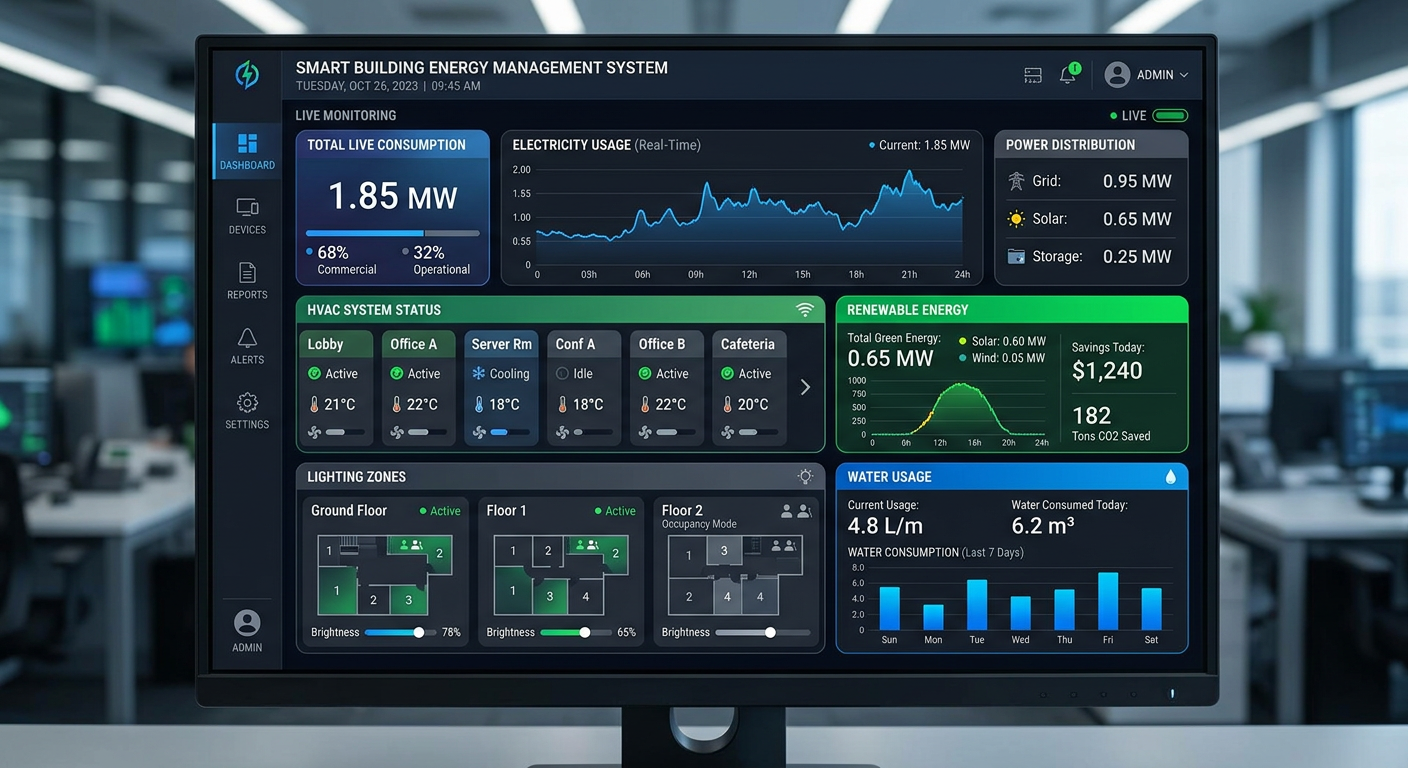
1. Demand-Based Energy Management
In traditional buildings, systems operate on fixed schedules. In smart buildings, energy consumption is adjusted according to actual demand. For example, if a floor is empty, lighting and climate control are reduced to a minimum level.
2. Peak Load Management
Energy costs vary throughout the day. Smart systems provide significant cost advantages by reducing energy consumption during peak tariff hours and shifting it to off-peak hours.
3. Carbon Footprint Tracking
Thanks to IoT sensors, a building's carbon emissions can be calculated in real time. This data is of critical importance for sustainability reporting and ESG compliance.
Remote Monitoring and Control
IoT-based building management systems make it possible to manage all building operations remotely, without geographical limitations.
- Mobile access: Facility managers can access all building data from their smartphones or tablets
- Multi-location management: Buildings in different cities can be monitored from a single dashboard
- Instant alarms and notifications: Critical situations (water leaks, extreme temperatures, power outages) are reported immediately
- Remote intervention: In emergencies, systems can be shut down or redirected remotely
Especially for multi-location businesses, remote monitoring dramatically increases operational efficiency. A facility manager can control the HVAC system of a building in Ankara from their office in Istanbul.
Preventive Maintenance and Fault Detection
In the traditional maintenance approach, equipment is either repaired when it fails (reactive maintenance) or serviced on a fixed schedule (periodic maintenance). IoT makes preventive (predictive) maintenance possible.
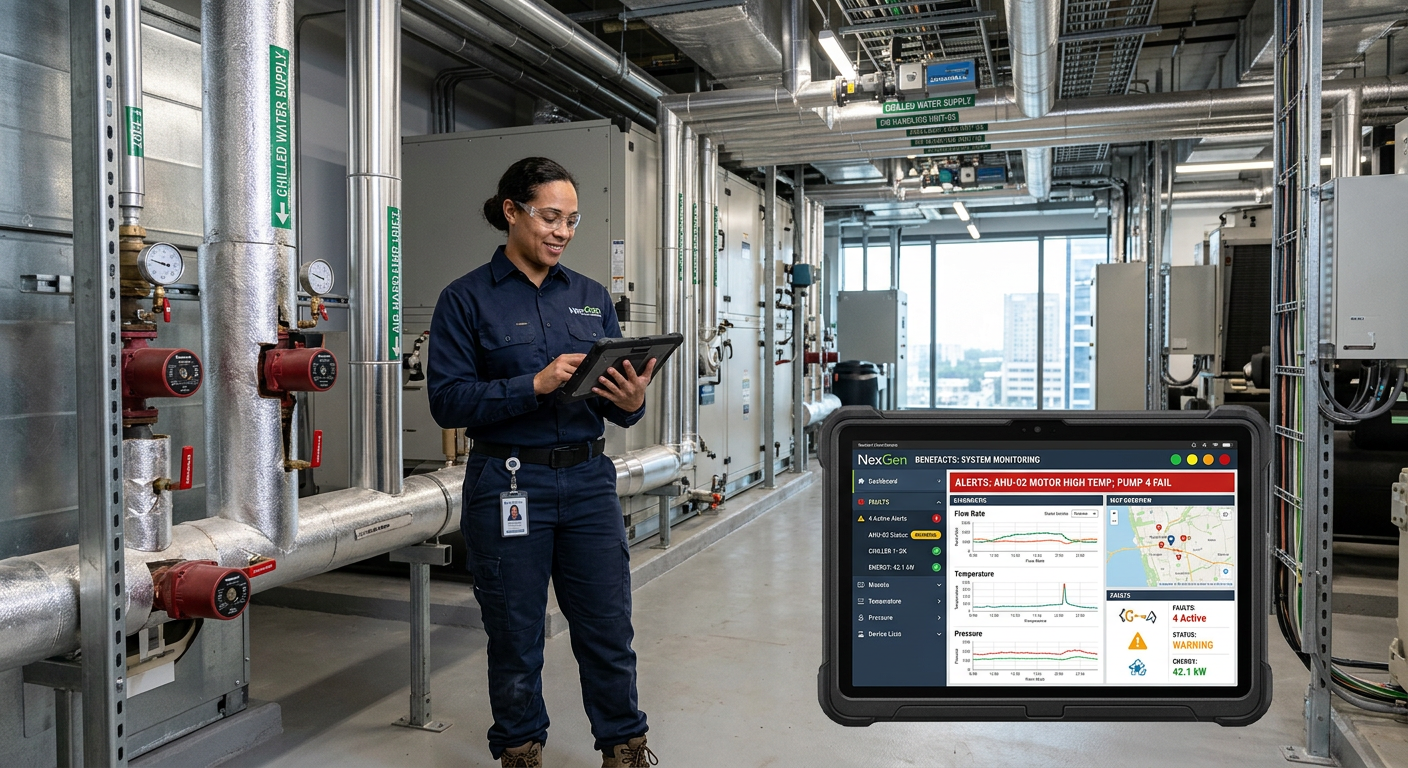
How Does It Work?
- Sensor data is continuously analyzed: Increased vibration, temperature anomalies, or performance degradation are detected
- Machine learning models: Deviations from normal operating patterns are automatically flagged
- Pre-failure warning: The maintenance team is notified before the equipment fails
- Automatic work order generation: Maintenance work orders are automatically created for detected issues
Benefits
- 50-70% reduction in unplanned downtime
- 25-30% savings in maintenance costs
- 20-40% extension of equipment lifespan
- Continuous improvement in energy efficiency
Security and Data Privacy in Smart Building Management
The proliferation of IoT devices also brings cybersecurity risks. Key points to consider for the security of smart building systems include:
- Network segmentation: IoT devices should be run on a network isolated from the corporate network
- Encrypted communication: Sensor data should be transmitted using TLS/SSL encryption
- Firmware updates: The software on IoT devices should be updated regularly
- Access control: Only authorized personnel should have access to the system
- Data retention policies: Data storage and deletion processes compliant with local regulations (like KVKK and GDPR) should be established
Security is a critical element for the sustainability of a smart building investment. An insecure IoT infrastructure can expose the business to serious risks.
Implementation Steps for Your Business
Transitioning to smart building management is a planned and phased process. Here are the recommended steps:
- Current state analysis: Assess your building's energy consumption, maintenance processes, and operational efficiency
- Identify priority areas: Start with the systems that have the highest savings potential (usually HVAC and lighting)
- Start a pilot project: Test IoT sensors on a single floor or section
- Data collection and analysis: Collect data for at least 3 months to measure the savings potential
- Scaling: Roll out the successful results to the entire building and other locations
- Integration: Integrate the building management system with your existing business processes (CMMS, ERP)
- Continuous improvement: Continuously optimize the system with data-driven decisions
Conclusion
Smart building management with IoT offers businesses significant advantages in energy savings, operational efficiency, and sustainability. With proper planning and phased implementation, businesses of all sizes can benefit from these technologies.
As WorkyBe, we support your business's digital transformation with our IoT integration, remote monitoring, and smart maintenance management solutions. Contact us to make the transition to smart building management.